

Company Profile
Automotive solenoid valves and sensors are our company's featured products. At the same time, our company is also a professional manufacturer specializing in the production of solenoid valve coils and special solenoid valves and other automation supporting components. Most of our products are used in pneumatic, hydraulic and other automation control component industries. At present, our products have been used by many internationally renowned brands and are deeply trusted by our customers.
Why Choose Us
Advanced Equipment
Flying Bull (Ningbo) Electronic Technology Co.,Ltd has an excellent team with more than 20 years of experience in design and development, focusing on the design, development and production of auto solenoid valve and sensor, engineering machinery solenoid valve and sensor.
Rich Experience
The company adheres to the business philosophy of "expert quality, global trust" and the business purpose of "pursuing quality, never ending".
High Quality
Quality is always our Flying Bull's unchanging concept. The company has established a research and development center, measurement room, laboratory, and chemical analysis room, and launches a number of high-tech products every year.
Professional Team
The company has strong R&D capabilities to lay a good foundation for the development and cooperation of new products for customers. First-class talents, advanced equipment, strict quality control system, scientific management, perfect service, and strong R&D capabilities, let us work together to become industry pioneers and win an unlimited future.


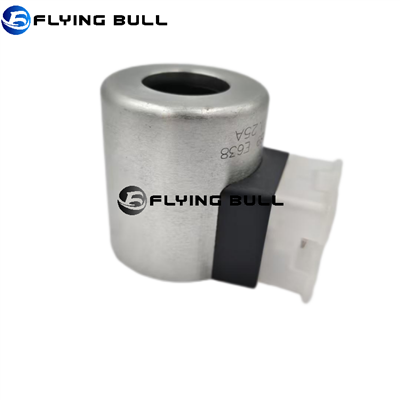


A solenoid valve coil is designed to convert electrical energy into lateral motion. The coil usually consists of copper wire wound around a hollow bobine or tube, so when electric current flows through the coil, a magnetic field is generated. By placing a solenoid valve coil over a ferromagnetic core (usually magnetic 430F stainless steel armature) the magnetic field generated causes the plunger to slide further up towards the magnetic field (into the coil) thus allowing an opening to be created. This in turn can be utilised to either to control direct acting solenoid valves, Assisted Lift Solenoid Valves or Servo/ Pressure Assisted solenoid valve.

Benefits of Solenoid Valve Coil
Simple Operation with Easy Network Connectivity
The solenoid valve’s simple structure is easy to install and maintain compared to other types of actuators such as sanitary regulating valves. What is more significant is that the composition of the automatic control system is much simpler and more cost-effective. As electro-mechanic switch signals control the solenoid valve, it’s very convenient to connect it to computers. In today’s world, where computer automation is widespread, the advantages of solenoid valve coil are even more apparent.
Lightweight Responsiveness & Energy-Saving Performance
Solenoid valve coil have response times as short as several milliseconds. Even the pilot solenoid valve can reach a response time in the tens of milliseconds. Due to self-looping, they’re more sensitive than other self-control valves, and the coil power consumption of a well-designed solenoid valve is very low. These energy-saving products can also be configured so that only one needs to trigger an action, and the valve positions are automatically kept. Plus, solenoid valve coil are small and lightweight, making them easy to install and maintain.
Limited Regulation Accuracy & Applicable Mediums
Usually, solenoid valve coil only have two states — “open” and “closed.” The valve core can only be in two extreme positions, and continuous regulation is impossible. Therefore, the regulation accuracy is very restricted. solenoid valve coil have a high requirement for the cleanliness of the medium. Mediums containing particles, viscous mediums, and mediums that are high in suspended solids are not compatible with solenoid valve coil.
Versatile Performance & Wide Application Range
Although solenoid valve coil have some inherent disadvantages, its advantages are still very prominent. solenoid valve coil are designed into a variety of products to meet various needs. They have a wide range of uses in applications like medical, dentistry, industrial, automotive, and more. The technological progress of solenoid valve coil centers around how to overcome inherent disadvantages and how to utilize its advantages better.
Type of Solenoid Valve Coil

Class F coils
Are rated to 155C, basically the copper wire windings can withstand a working temperature up to, but not exceeding +155C. This is the most common form of solenoid coil for pneumatic systems and are ideally suited to working ambient temperatures up to +20C and media up to +100C.

Class H coils
Are rated to 180C, basically the copper wire windings can withstand a working temperature up to but not exceeding +180C. These are a common form of solenoid coil for standard and some steam valves and are ideally suited to working ambient temperatures up to +50C and media up to +180C.

Class N coils
Are rated to 200C, basically the copper wire windings can withstand a working temperature up to but not exceeding +200C. These are more specialist solenoid coils and are ideally suited to working ambient temperatures up to +80C and media up to +200C.
Locking Mechanisms
Solenoid valve coil are found as part of an automatic locking mechanism, such as door locks for high security areas and restricted access rooms. When the locking mechanism is in the locked position, the solenoid coil is not charged. With the addition of electrical energy, the solenoid coil activates and unlocks.
Medical Applications
Solenoid valve coil are an essential part of medical equipment since medical devices have to be precise, accurate, and reliable. Manufacturers are required to adhere to exceptionally restrictive standards to prevent any possibility of solenoid coil failure. In dialysis machines, there are two solenoid valve coil that control blood flow. solenoid valve coil can be found in dosing machines that control the flow of medications to patients. Other medical devices that use solenoid valve coil include oxygen delivery systems, diagnostic equipment, patient monitoring, respirators, and gas chromatography.
Automotive
Solenoid valve coil are an essential part of the increase in automation in the production of automobiles. They are used for interlocking in the gearbox drive selector, an important part of the drive selection process. solenoid valve coil are found in air conditioning controls, entertainment mechanisms, and security systems.
Irrigation System
A solenoid coil for an irrigation system manages the flow of water by turning it on and off to stop or release water into the system. There are several types of solenoid valve coil used for irrigation systems that are capable of fitting underground. They have a screw attached to the plumbing and wires for electrical activation.
Irrigation solenoid valve coil are attached to an electronic timer that is set to water lawns at a specific time. In some cases, irrigation solenoid valve coil can get blocked by dirt, soil, or other particles; this can disrupt their function and force them to stay open.
How to Choose a Suitable High-Quality Solenoid Coil
When it is necessary to select a suitable solenoid valve coil for a solenoid valve, Beris team recommends to consider from four aspects, They are matching, reliability, safety, and economy.
Matching
Matching refers to whether the performance and structure of the solenoid coil can match the use requirements of the corresponding solenoid valve.
Reliability:
First of all, please choose the solenoid valve coil made by a professional manufacturer, secondly, choose the higher quality grade, its reliability is relatively high.
Safety
We must focus on whether the selected solenoid coil matches the use environment of the solenoid valve, especially the special use environment,Waterproof solenoid coils must be used in environments with waterproof conditions, such as solenoid valves for outdoor use or fountains, etc.
The maximum nominal pressure of the solenoid valve coil calibration must exceed the maximum pressure in the pipeline, otherwise the service life will be shortened or other unexpected situations will occur.
Economy
In many cases, the solenoid valve coil can be universal, but try to choose the most economical product on the basis of meeting the above three points, to save costs. Beris Electronic will provide you with various types of solenoid coils with the best cost - effective performance.
Solenoid Valve Coil Voltages: What's the difference
Solenoid valves are controlled by electrisation of a solenoid coil, which when electralised, produce a magnetic field that results in some further desired effect: e.g. the movement of a spool within a valve body, thereby changing the pneumatic flow path.
Cost
The cost of building a pneumatic system to be used with DC (direct current) supply is greater than a system with AC (alternating current) supply. This is because the operating current of DC supply is higher than that of AC supply, and procedures must be in place to preclude voltage drops on the return line
Inrush Current and Holding Current
However, AC solenoids often have a high inrush current followed by a low holding current. One consequence is that when the spool jams, there is constant high current which can damage the coil via overuse and/or overheating. This result is otherwise known as a coil 'burn out', and are almost exclusive to AC coils. However, burn out coils may not be due to a fault in the coil, but due to a fault in the valve; namely, a jammed spool.
Undervoltage
For pneumatic solenoid valve coils, there is usually a working range of ±15% of rated voltage. For example, if the rated voltage is AC220v, then the minimum working end of the voltage would be ~AC187v. However, if the voltage is too low, the technician may experience a number of symptoms.
Overvoltage
Coils in pneumatic solenoid valves can also be overvolted. In these cases, there will be a greater response time from the valve – e.g. the spool moves quicker – which may be a desired effect. This is not to say that the pneumatic cylinder will actuate faster, but that there is less time between electrisation of the coil, and the change in flow path. Some operators may even intentionally overvolt a solenoid coil.
How to Troubleshoot Solenoid Valve Coil Heating
When the solenoid valve is working, it is found that the coil of solenoid valve get hot. The reason for this solenoid valve coil heating may be caused by long-term operation of the solenoid valve. However, if only the temperature is in the proper range of the solenoid valve, the heating will not affect the normal operation of the solenoid valve coil. If the temperature is too high, it will affect the working efficiency of the solenoid valve, or even damage its parts.
Firstly, check whether the temperature of the solenoid valve coil is in a proper range. Refer to the product manual please. Generally there is the working and ambient temperature of solenoid valve in the product manual. If there’s not, please consult to the manufacturer according to product model. General, a slight heating is a normal phenomenon for the solenoid valve. Please don’t worry only if the temperature doesn’t exceed a specific value.
Secondly, wrong selection for two kinds of normally open and normally closed solenoid valves may also cause the solenoid valve heating. If the user selects a normally closed valve while it’s normally open in actual operation, it’s easy to cause overheating of the solenoid valve coil. In case of this reason, a new solenoid valve has to be replaced. So it’s important for user’s model selection.
Thirdly, if the solenoid valve coil is equipped with an energy-saving protection module (the function of energy-saving module is to save energy and cool the solenoid valve coil), the coil would also get hot once the energy-saving protection module gets fault.
Then, the solenoid valve does overload work, namely the actual working conditions of solenoid valve exceeds the designed working environment of solenoid valve. For example, the ambient and medium temperatures are too high, or the working pressure is excessive and supply voltage is too big.
The conventional structure of a solenoid valve coil includes: framework, Enameled copper wire, pin, Yoke and encapsulation. In addition, according to the actual use, there will be a magnetizing guide ring, a rectifier bridge be used for rectifying, etc.
Enameled copper wire
Copper conductor with a coat of insulating paint on its surface, which is the core material of the Solenoid valve coil. Solenoid coils used in valves are designed and tested for continuous service. They all meet the thermal endurance specifications according to IEC 216
Bobbin
The bobbin is the carrier of enameled wire winding. According to the temperature rise of the valve coils and the actual use environment, different bobbin materials are selected, such as PA66, PPS, PBT, pet, etc., and a few of them are thermosetting BMC and PT-310
Pin
The function of the pin is to realize the electrical connection between the internal enameled wire and the outside, similar to the same role are terminals, flying leads and so on. Pin material is generally brass, such as H59, H62, H65, of which H62 is the most.
Yoke
It is used to gather the magnetic field lines from the N pole to the S pole, increase the magnetic field strength and minimize the magnetic leakage into the air. A reasonable yoke structure design is conducive to improving the magnetic field strength. Generally, there are two kinds of yoke materials: low carbon steel cold-rolled plate and electrical pure iron (DT4C).
Encapsulation
It is used to combine the solenoid coil parts into a whole, which plays a role of waterproof and dustproof. The materials include thermosetting and thermoplastic.
Precautions for maintaining solenoid valve coils include regular cleaning and dust removal. Use a lint-free cloth to gently wipe the surface of the coil to remove dust and debris. Check connections and cables regularly to make sure fasteners are not loose and cables have no frayed or exposed wires. If damage, corrosion or scratches are found on the surface of the coil, please replace or repair it in time to avoid affecting the performance and life of the coil.
In addition, regular electrical testing and functional inspections are important steps in maintaining solenoid valve coils. Use suitable test equipment to check parameters such as coil resistance, current and voltage. At the same time, make sure that the opening and closing action of the solenoid valve is normal, and check whether there is any abnormal noise or vibration.
When encountering maintenance common problems, you can take corresponding solutions. For example, if it is found that the solenoid valve coil is not working properly, you can check whether the power supply is stable, whether the coil is damaged, or whether the control signal is correct. If the coil heat is too high, you can consider increasing the heat dissipation measures or adjusting the current limit. If the solenoid valve operates unstable or has abnormal noise, check whether the valve and connecting parts are loose or worn. If it is found that the solenoid valve is poorly sealed or leaks, you can check whether the seal is intact and replace it in due course.
Automotive solenoid valves and sensors are our company's featured products. At the same time, our company is also a professional manufacturer specializing in the production of solenoid valve coils and special solenoid valves and other automation supporting components.


Our Certificate


FAQ
As one of the leading solenoid valve coil manufacturers and suppliers in China, we warmly welcome you to buy high-grade solenoid valve coil made in China here from our factory. All customized products are with high quality and competitive price.
