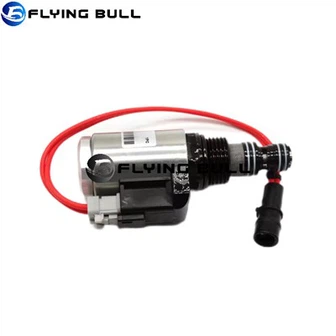
Introduction And Working Principle Of Solenoid Valve
Introduction:
Solenoid valve is an industrial equipment controlled by electromagnetics. It is an automatic basic component used to control fluids. It belongs to an actuator and is not limited to hydraulic and pneumatic. It is used in industrial control systems to adjust the direction, flow, speed and other parameters of the medium. Solenoid valves can be used with different circuits to achieve the expected control, and the accuracy and flexibility of the control can be guaranteed. There are many kinds of solenoid valves, and different solenoid valves play a role in different positions of the control system. The most commonly used ones are check valves, safety valves, directional control valves, speed regulating valves, etc.
Working principle:
There is a closed cavity in the solenoid valve, with through holes at different positions. Each hole is connected to a different oil pipe. There is a piston in the middle of the cavity and two electromagnets on both sides. The valve body will be attracted to which side the magnet coil is energized. By controlling the movement of the valve body to open or close different oil drain holes, and the oil inlet hole is normally open, the hydraulic oil will enter different oil drain pipes, and then the piston of the oil cylinder is pushed by the oil pressure, and the piston drives the piston rod, and the piston rod drives the mechanical device. In this way, the mechanical movement is controlled by controlling the on and off of the current in the electromagnet.