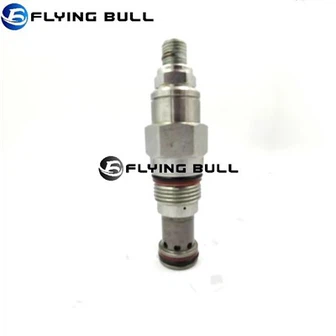
What is the Function of a Transmission Solenoid Valve?
The functions of a transmission solenoid valve include:
1. Adjusting the vehicle's driving speed and providing appropriate driving force based on changing road conditions and driving requirements.
2. Engaging or disengaging engine power as needed, allowing the engine to effectively transmit power or operate at idle.
3. Altering the direction of the vehicle's power output through gear shifting, thereby enabling both forward and reverse motion.
A solenoid valve is a fundamental automated component used to control fluid flow; it functions as an actuator and is not limited to hydraulic or pneumatic systems. In industrial control systems, it is utilized to regulate the direction, flow rate, velocity, and other parameters of a fluid medium. Solenoid valves can be integrated with various electrical circuits to achieve specific control objectives, ensuring both high precision and operational flexibility.
Inside the solenoid valve, there is a sealed chamber featuring various ports positioned at different locations, with each port connected to a specific fluid line. A piston is situated in the center of the chamber, flanked by two electromagnets. When the coil of an electromagnet on one side is energized, the valve body is drawn toward that side; by controlling this movement of the valve body, specific fluid outlet ports are opened or closed.
The fluid inlet port remains continuously open, allowing hydraulic fluid to flow into the various outlet lines. The pressure of this fluid then drives the piston within a hydraulic cylinder; the piston, in turn, actuates a piston rod, which subsequently drives a mechanical mechanism. Thus, by controlling the energization and de-energization of the electromagnets, precise mechanical motion is achieved.
The primary parameters to consider when selecting a solenoid valve include its nominal diameter (bore size), design nominal pressure, permissible temperature range for the medium, and interface dimensions. Solenoid valves utilize electromagnets to actuate the opening and closing of the valve mechanism; they are typically employed in two-position control applications involving bore sizes of 40 mm or less, and are particularly common in systems designed to switch, cut off, or divert the flow of air or liquid.
The sealing performance of a valve is one of the primary indicators used to assess its overall quality. Valve sealing performance encompasses two main aspects: internal leakage and external leakage. Internal leakage refers to the degree of fluid tightness achieved between the valve seat and the closing element. External leakage refers to any leakage occurring at the valve stem packing, at the body-to-bonnet gasket joint, or through the valve body itself due to casting defects. External leakage is strictly impermissible.